

Rhodes Old Town Walking Tour: Self-Guided Itinerary
Table of Contents
Rhodes Old Town is best understood on foot
A Rhodes Old Town walking tour is not just a way to move between monuments. It is the best way to understand why this part of the island feels so different from the beach resorts, harbours and villages around it.
Inside the walls, Rhodes does not unfold as a simple “old town” with a main square and a few postcard streets. It is a layered city: ancient foundations below the surface, Byzantine traces in reused churches, the medieval geometry of the Knights of St John, Ottoman mosques and fountains, Jewish residential streets, and Italian-era restorations that still shape the way visitors see the city today.
That is why a self-guided walk works well here, as long as it has a clear route. Without one, it is easy to spend two hours drifting through shops and restaurants while missing the reason the Old Town became one of the most important historic urban ensembles in the Mediterranean.
Before you start: how much time do you need?
For a first visit, allow around two to three hours for a relaxed self-guided route. That is enough time to enter through one of the main gates, walk the Street of the Knights, see the Grand Master’s Palace from the outside, continue toward the lower town, and finish in quieter lanes away from the busiest tourist flow.
If you want to visit the Palace of the Grand Master or the Archaeological Museum properly, add at least another hour. These are not quick “tick the box” stops. The palace especially makes more sense when you understand its layered history: Byzantine citadel, headquarters of the Knights, Italian restoration, and museum space.
Wear comfortable shoes. The Old Town is beautiful, but it is not smooth. Cobbled streets, stone steps and uneven paving are part of the experience, and they are also the reason this walk should be planned at a human pace rather than rushed between photo stops.
Start at the Sea Gate or Liberty Gate
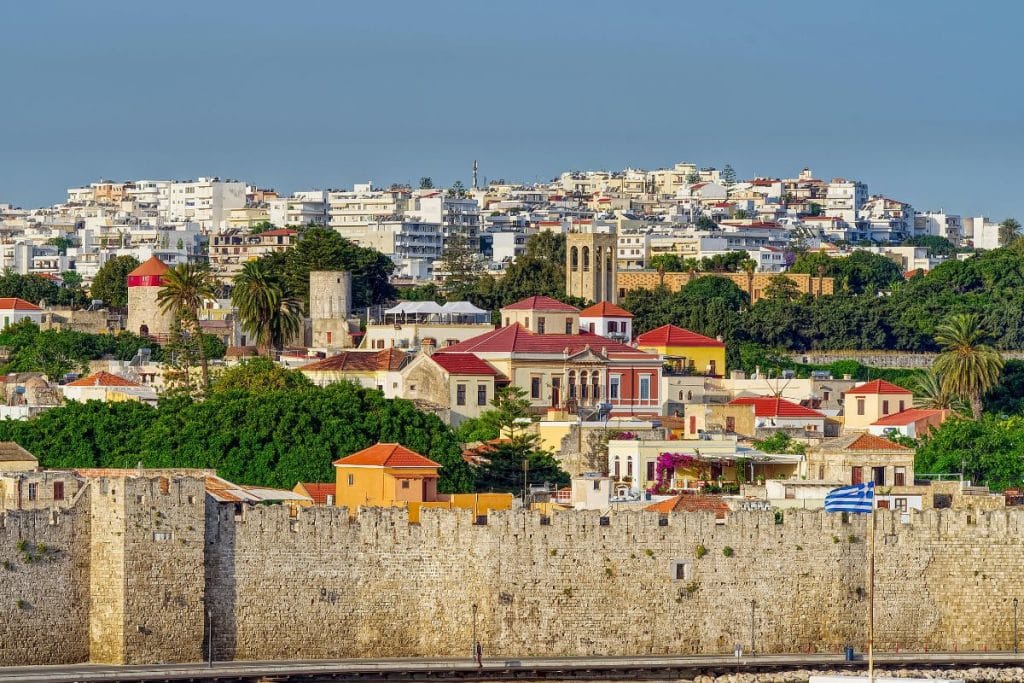
A practical Rhodes Old Town walking tour can begin at the Sea Gate if you are coming from the harbour, or at Liberty Gate if you are approaching from the modern city. Both entrances immediately remind you that the Old Town was not designed as a decorative quarter. It was a defended city.
Pause before walking in. The walls are not just a backdrop. They frame the entire experience. The medieval city sits inside a fortified system that was shaped and strengthened over centuries, especially during the period of the Knights of St John. UNESCO describes the Medieval City of Rhodes as a place where the Palace of the Grand Masters, the Great Hospital and the Street of the Knights form one of the finest Gothic urban ensembles of the period, while the lower town preserves later Ottoman layers.
From the gate, avoid rushing straight to the busiest commercial streets. The first few minutes are useful for orientation: harbour outside, fortifications around you, and a city plan that still carries the logic of defence, administration and daily life.
Walk up to the Palace of the Grand Master
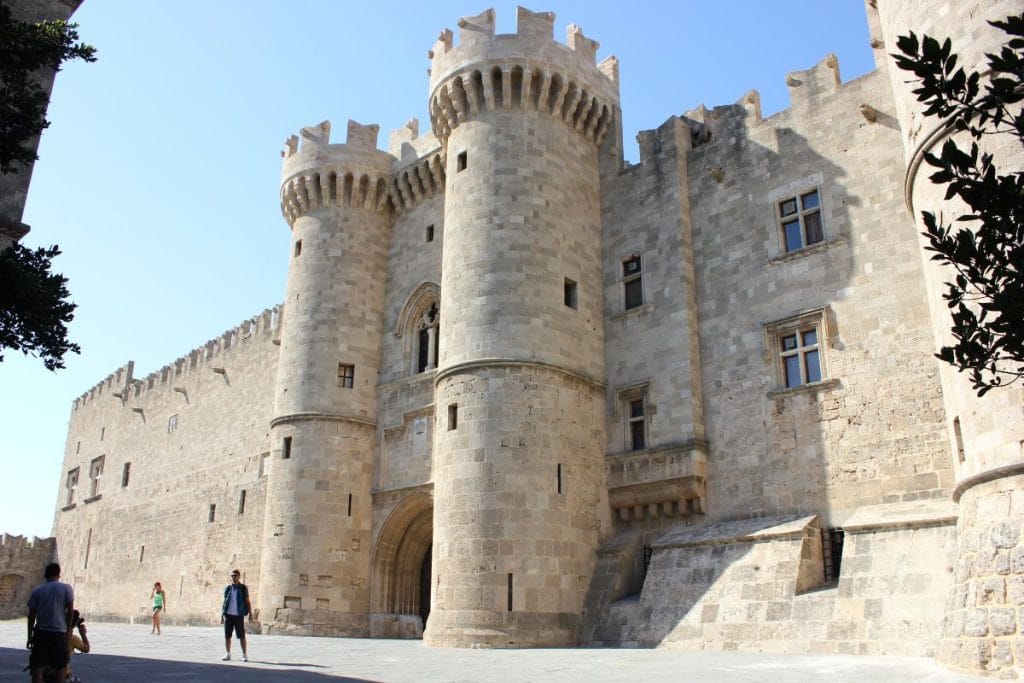
The Palace of the Grand Master is the most obvious landmark in Rhodes Old Town, but it is also one of the easiest to misunderstand. Many visitors see it as a single medieval castle. In reality, it is a building with several lives.
The site began as part of the city’s defensive and administrative structure. Under the Knights of St John, it became the seat of the Grand Master and a symbol of the Order’s power in the eastern Mediterranean. Later damage, restoration and Italian-era interventions shaped much of what visitors see today.
On a self-guided itinerary, the palace works as the anchor point of the upper town. Even if you do not enter, take time to look at the scale of the walls, the approach, the courtyard area and the way the building dominates nearby streets. If you do enter, do not treat the rooms only as interiors. Look for the mixture of medieval atmosphere, restored spaces and museum displays. This is where a guided visit can add real value, because the building does not explain all of its own historical changes clearly to a first-time visitor.
Continue along the Street of the Knights
From the palace, continue into the Street of the Knights, one of the most atmospheric streets in Rhodes and one of the clearest examples of why the Old Town should be walked slowly.
This was not an ordinary residential street. It was connected with the organisation of the Knights of St John, whose members were divided into “tongues”, or language-based divisions. The inns along the street belonged to different national groups within the Order, which is why the façades feel formal, almost institutional, rather than domestic.
The mistake here is to walk too fast. The Street of the Knights is short, but it rewards attention. Look at the coats of arms, the stonework, the rhythm of the buildings, the way the street rises, and the absence of modern visual clutter. It is one of the few places in Rhodes where the medieval layer still reads almost without interruption.
For travellers who enjoy symbolism, chivalric history or the hidden logic of buildings, this street is also where a more specialised guided walk can change the experience. A self-guided route gives you the setting; interpretation gives you the code.
Stop by the Great Hospital and the Archaeological Museum
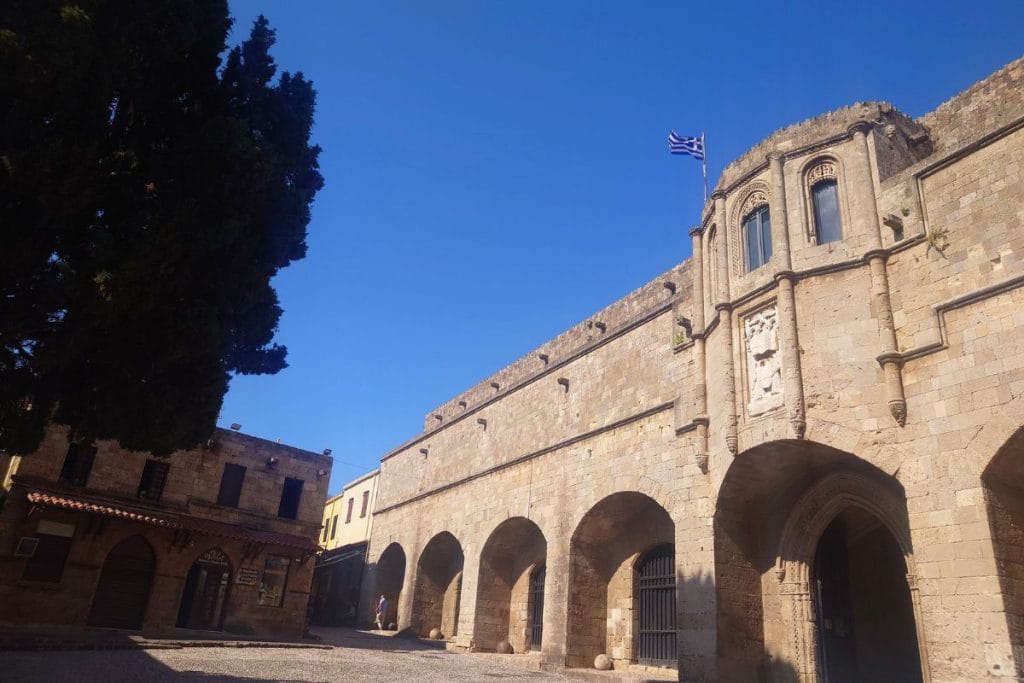
At the lower end of the Street of the Knights stands the former Hospital of the Knights, now home to the Archaeological Museum of Rhodes. Even if you do not go inside, the building deserves attention.
The Knights were not only a military order. Their identity was also hospital-based, and that dual role is visible in the architecture of the Old Town. The Great Hospital represents the charitable and medical side of the Order, while the palace and fortifications express authority and defence.
If you have time to enter the museum, this is where the Old Town connects back to ancient Rhodes. The city is often marketed through its medieval character, but the island’s history is much older. Museum collections help bridge that gap, placing the medieval streets within a longer story of Greek, Hellenistic and Roman Rhodes.
Move toward the lower town: mosques, fountains and daily life
After the main medieval monuments, turn away from the most photographed streets and move into the lower town. This part of Rhodes Old Town is essential because it prevents the walk from becoming only a story of knights and castles.
After the Ottoman conquest, the city did not disappear and start again. It was adapted. Churches were converted, new mosques appeared, public baths and fountains became part of daily life, and residential patterns changed. The result is not a clean separation between “medieval” and “Ottoman” Rhodes, but a city where periods overlap.
This is where your walking tour should slow down. Look for small fountains, shaded corners, minarets, enclosed courtyards and streets that feel more lived-in than monumental. The Old Town is not only a museum. It is also a residential and commercial environment that has survived by being reused.
Walk into the Jewish Quarter
The southeastern part of the Old Town leads toward the Jewish Quarter, often known as La Juderia. This is one of the most important parts of a thoughtful Rhodes Old Town walking tour, and it is also one of the areas many visitors miss if they stay on the busiest route.
The streets here feel quieter and more intimate. The scale changes. Instead of grand façades and military architecture, the quarter asks for a different kind of attention: residential lanes, memory, community history and absence.
If you are including the Jewish Quarter in your walk, do it respectfully. This is not a decorative detour. It is part of the island’s wider history and one of the reasons Rhodes cannot be reduced to a single medieval postcard image.
Leave space for aimless wandering
A good self-guided itinerary needs structure, but Rhodes Old Town also needs unplanned time. After you have covered the palace, Street of the Knights, Great Hospital, lower town and Jewish Quarter, give yourself permission to wander.
This is where the city becomes more human. You may find a quiet archway, a courtyard, a lane where laundry hangs above medieval stone, or a small square where the historical layers are not labelled but still visible. These moments are often more memorable than the formal stops.
The key is to wander after you understand the outline. If you wander first, the Old Town can feel like a maze. If you wander after the main route, the maze starts to make sense.
Self-guided or guided: which works better?
A self-guided Rhodes Old Town walking tour is ideal if you like moving at your own pace, stopping for photos, changing direction and letting the city reveal itself gradually. It is also a good choice if you are travelling with children, visiting in hot weather, or combining the walk with lunch, shopping or a harbour stroll.
A guided experience makes more sense when the subject is interpretive rather than visual. The Palace of the Grand Master, the Street of the Knights, the symbols on the buildings and the less obvious stories of the Order of St John are much richer when someone explains what you are looking at. The same is true for more specialised themes, such as chivalry, hidden symbols and the intellectual history of the walled city.
The best approach is not to treat self-guided and guided as opposites. Use a self-guided route to understand the shape of the Old Town. Choose a guided visit only for the parts where context changes what you see.
A simple self-guided route to follow
Here is an easy route for a first visit:
Start at the Sea Gate or Liberty Gate. Walk toward the Palace of the Grand Master and spend time around the upper town. Continue down the Street of the Knights, stopping to look at the façades and coats of arms. Pause at the Great Hospital and decide whether to enter the Archaeological Museum. From there, move into the lower town to notice the Ottoman layers: mosques, fountains, shaded streets and domestic architecture. Continue toward the Jewish Quarter before looping back through quieter lanes toward the harbour or one of the main squares.
This route is not designed to cover everything. It is designed to stop the Old Town from becoming a blur. In Rhodes, the best walking itinerary is not the one with the most stops; it is the one that helps you read the city more clearly.
What to keep in mind before you go
Start your Rhodes Old Town walking tour early in summer if you want quieter streets and better light. Late afternoon also works well, especially if you prefer a slower, more atmospheric walk. Midday can be tiring, not because the distances are long, but because the heat reflects off the stone and shade is uneven.
Do not rely only on maps. They are useful for direction, but the Old Town is best understood by sequence: gate, palace, Street of the Knights, hospital, lower town, Jewish Quarter, quiet lanes. That order gives the walk a story.
Finally, remember that Rhodes Old Town is still a living place. People work, eat, pray, shop and return home inside the walls. Walk with curiosity, but also with patience. The more slowly you move, the more the city gives back.